The power and the glory: the real story of the FIFA World Cup
Written by Ciaran Myers on 11th December 2025
Football isn’t only a game between 22 players on a pitch – it’s also about the game of international power on this planet.
Not to mention the love of a Sunderland-born author for his home club and city.
Spark’s Ciaran Myers discovered this when he met Guardian journalist Jonathan Wilson.

Football journalist and author (right) in conversation with Professor Brian Ward during the Newcastle Book Festival.
Credit: Spark
It’s perhaps not often that an author sees first-hand the popularity of their new book.
But Jonathan Wilson did, when copies of his latest book: The Power and The Glory: A New History of the World Cup ran out during his appearance at Newcastle City Library.
A member of the library team was sent scurrying across Northumberland Street to Waterstones to find more for him to sign, giving Wilson a glimpse of the success he has written for himself.
A Friday afternoon at the Library saw a roomful of football aficionados congregate to hear from the four-time Football Supporters’ Association Football Writer of the Year.
Northumberland University’s Professor Brian Ward hosted the conversation, as Wilson recited tales of World Cups gone by.
From the training onboard the ship that took France, Yugoslavia and Romania to the first tournament in Uruguay, Sunderland beating eventual champions Spain in a friendly and the 1998 ‘Ronaldo final’, the talk was a tease as to what the book contained.
Stories to recount to your friends as you watch Donald Trump attempt to overshadow the greatest tournament in sports.
After the book signing, Spark had the chance to sit down with Wilson and discuss the book, the upcoming tournament and, of course, his beloved Sunderland.
The Sunderland-born, Oxford-educated journalist revealed that a book of this type had been on the to-do list for many years.
“Probably I’ve wanted to write a World Cup book since I was about seven,” he said.
However, Brian Glanville’s The Story of the World Cup, originally published in 1993 and updated frequently, has long been the defining book on the subject, making getting a new one on the shelves a tough task.
“I think Brian’s book is the reason why nobody’s tried to do a full history of the World Cup since his book,” said Jonathan. “But you look at it now and it’s a slightly old-fashioned book, because he didn’t have all the information we have.
“He couldn’t get access to every newspaper ever published in Argentina or Hungary or wherever. His is a great book but it’s a book written from a notebook and a book of his generation.
“Brian was a huge influence and a good friend, but different eras produce different types of book.”
Glanville sadly passed in May, which for Wilson made the timing of his book a touch more poignant – a natural ‘passing of the baton’.
“It feels almost like he had to get off the stage before my book could come onto it,” he said.
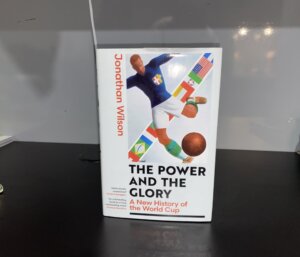
Jonathan Wilson: The Power and the Glory: A New History of the World Cup.
Politics, prices and penalties…
The presence of Donald Trump at the upcoming tournament has already been seen in the draw conducted last week in Washington.
The unpredictability of the President may lead to an updated version being required soon after the summer. The author is fully aware and hoping to provide regular updates to the book.
“I hope the publishers will want me to update it every four years,” he said.
“I think this World Cup coming, there are lots of potential political issues. I think the relationships between the three host nations are obviously tense.
“At all previous 22 World Cups, at least part of the aim of the hosts has been to say to people ‘Come to our country, see how brilliant it is. Go home tell your mates. Yes, Italy is brilliant. Yes, Argentina is brilliant.’ Even Qatar – if you’re gay or Jewish, you probably wouldn’t say this – but I think on some level that was the aim.
“Whereas, the US is the first host to be actively hostile to the rest of the world.
“Haiti and Iran are both on the 14 banned country list. Their players will be allowed to go because they get special dispensation as lead sports people. I’m not sure even all their backroom staff will be able to go, fans will clearly not be able to go. That has never been true before.
“There had been an issue that for Ecuador, Columbia… certainly for other countries as well: if you waited until qualification had been guaranteed then applied for an interview, the wait time for an interview would’ve been after the tournament. They have said they’re going to expedite that, how it works in practice we will see.
“But you contrast this to 2017, where [Gianni] Infantino said to Putin: ‘If a ticket doesn’t guarantee a visa, we will take the tournament off you’ and you look now, how he’s just nodding along with everything Trump says in the Oval Office, the change in approach is appalling.”
Ticket prices are also an issue entering the summer, with many local, working-class fans being priced out.
Those who travel to support their nations will also have to fork out huge sums of money to get into the stadiums.
Wilson said: “I guess it’s a FIFA issue. I was sort of imagining if you’re a Scotland fan and you have that incredible game – all that drama and you’re on that massive high after beating Denmark – and you’re in the pub after celebrating [and you say] ‘Let’s have a look at tickets in the morning – we’ll go over’.
“Then you have a look online in the morning and it’s $1,200 for one ticket!
“Football’s always been the working-man’s game, its always been the game for everybody, and if you’re charging those sort of prices, it’s obviously not.
“Having said that, it is the market – and America is a country driven by the market, for better or for worse.
“I do fear there’ll be games – like Uzbekistan vs Panama in Arlington – how many people are going to go watch that? I don’t know but I suspect not many. But maybe the economics will work for them.
“Clearly, the prices are prohibitive for a huge number of people.”
A ‘temperature check on the world’
A reader of a Jonathan Wilson book will not only come away having learned huge amounts about football but also the society in which it is played.
He believes that the World Cup is a window into the wider world and studying it helps us to understand the political climate of the time: “I think it’s a four-yearly temperature check on the world.
“Some World Cups are more obvious than others.
“So 1938; the fact that Spain aren’t there because of a Civil War; the fact that China aren’t there because they’ve been invaded by Japan; the fact that Austria have been subsumed into Germany.
“All the anti-fascist protests in games; the fact that Italy wear black in their quarter-final against France to make a point; that very clearly gives you an idea of where Europe was at the end of the ’30s.
“Or you have ’74, which was the great tournament of the Cold War, and you end up with West Germany playing East Germany in the group stage. The fact that you have the Soviets refusing to play a play-off against Pinochet’s Chile and also you’ve had the oil shock the previous autumn.
“I think the first time Saudi Arabia appear in the book is 1974 and, obviously, the Middle East becomes a bigger and bigger player in football – but because it’s a bigger and bigger player on the global stage because of oil.
“It’s a snapshot every four years, but that’s actually quite a useful process to see how things change.
“The fact that now we’re living in this era of authoritarian populism, you can see even in 2010, 2014 were World Cups where FIFA was like a colonial power which went into a country who were desperate for the approval of FIFA, and FIFA basically pillages them.
“Says ‘Right, you don’t tax our profits, you’re responsible for all the revenues, we’ll take all the revenues’ … and Brazil and SA lose huge amounts of money.
“It’s kind of disastrous for them, they’ve been left with all these white elephant stadiums that they can’t do anything with.
“Then you move to 2018, 2022 with all these authoritarian states, who don’t really care about the cost because they’re playing in a different game. They’re not really doing it for profit, they’re doing it to unveil themselves on the world stage. I guess, ’26 and ’30 will be different, but Saudi Arabia in ’34 is the same.”
A love supreme, ’til the end
Wilson is also a lifelong Sunderland fan.
In the days leading up to our chat, I came across a clip from the Libero Podcast, of which he is a co-host, where he said following Sunderland’s semi-final play-off triumph over Coventry that it would be ‘better to go up next year’. He chuckles when I remind him of his words, clearly delighted to be proved wrong by the Black Cats’ performances.
While revelling in the early-season form, Wilson is cautious about the future, saying: “They’re not going to maintain it, but hopefully they’re going to stay up now.
“My attitude after the play-off final was ‘This has been a brilliant day, maybe the best one-off occasion since ’73 and the cup final. Let’s enjoy this, let’s enjoy it for a week and let’s not worry about next season, because it’s going to be awful next season. We have to accept that we might break the record for the lowest points total’.
“Then, the first 10 days of the transfer window Sunderland sign, I think, seven players – and not just any players but people like Noah Sadiki, who I had heard great things about. And it was ‘Hang on, why’s he joining us?’.
“Then we get [Nordi] Mukiele. ‘Hang on, the Mukiele who was really good at Leipzig and has had one slightly dodgy season at PSG and we’ve got him for 9.5 million? How’s that happened?’
“So that very early movement in the transfer market, it sort of said they’ve got a plan, they’ve got cash. Maybe this isn’t hopeless.
“Then the fixture list comes out and you see the first four home games were West Ham, Brentford, Villa (when they were in their weird mood) and then Wolves. ‘Hang on, there’s points on the board!’
“The stats show that, as a newly promoted side you’ve got to take eight points from your first five games to have a chance. They got eight points from the first five games.
“I think the recruitment’s been incredibly smart. Something Ivan Juric said [after being relegated with Southampton last season]: ‘I expected us to be technically and tactically inferior to every team we played, but I didn’t think we’d be physically inferior’.
“If you look at the players they’d signed, they were all big, they were all really physically and muscular players, but Sunderland have got players who can actually play as well.
“Mukiele is a physical monster but he’s great on the ball; [Omar] Alderete the same; [Granit] Xhaka the same; Sadiki the same. They’ve obviously recognised that physicality is key and you see them against Arsenal and they really physically challenged them in a way I don’t think any other team has this season.
“The fixtures have been kind, they will get together, momentum will dry up. But they’re probably five wins from staying up and you hope five wins in 26 games is possible, and then hopefully they can build up again.
“They’re going to lose seven players potentially to the [African] Cup of Nations, particularly at left-back. That’s a problem. I think the rest of the team can just about cope but that clearly is going to make things harder.
“It’s a far better start than I thought possible.”
A Mackem proud of his home city
Supporting Sunderland is a big part of Wilson’s identity.
You can see the passion he shows when talking about not just the football club but the city as a whole. I asked him why it is such a huge part of not only his identity but the city’s wider image.
“I don’t understand – and I accept this is me being different – but I don’t understand people who choose their club: I was born with it,” he says.
“I get I’m lucky. I was born in a city with a very pronounced football culture to a family that cared a lot about football. Not everyone will have that.
“It’s a part of my identity that is irremovable. It feels the same as being born with this colour hair, these arms – it’s what I was given.
“I think whenever they play in a major final, that taking over Trafalgar Square, it is an act of saying ‘Remember us, we’re still here’. Maybe that’s not justifiable – but there is that mentality there.
“After the play-off final, me and my mates, we went down to Trafalgar Square to see what was going on and there was a whole load of people saluting the statue of Henry Havelock, because Havelock was from Sunderland. And the police were saying ‘What are you doing?’ [The fans’ response was:] ‘He’s from Sunderland!’
“That’s just a great thing.”
He continues: “In terms of the city, I think this is true of a lot of post-industrial cities. Where do you ever see Sunderland on the news? It’s in a football context. Certainly in a positive light.
“My feeling in the last three or four years is that Sunderland – the city – is suddenly moving forward in a way it hasn’t done in my lifetime.
“Suddenly, a whole load of cafes, bars, restaurants; loads of redevelopment of the seafront; the city centre, effectively moving the centre of town from Market Square to Keel Square. The Sheepfolds is part of that, and that is clearly part of the football stadium redevelopment.
“The new bridge [the Keel crossing] I think is a huge thing. In terms of just people spilling out the ground and going having a pint, that’s got to add an extra 10,000 pints, 20,000 pints and that’s got to be good for the city.
“The fact the football club have been promoted and are moving forward, hopefully those two things can go in tandem. Even things like the new city hall, the new eye hospital, the new battery recycling plant, the sustainable aviation fuel, the whole ‘smart city’ thing. All of that seems incredibly far-sighted.
“Driverless buses! We’ve got driverless buses in Sunderland – why is that not shouted about more? I don’t think any other city has driverless buses.
“When did we become the future?
“But we are and that’s really exciting, and I just hope that the council elections next summer don’t put a spanner in that.”
Wilson is an individual who is passionate about telling footballing stories from around the world.
His work is well-researched and brilliantly written, so if you are looking to learn about previous iterations of the World Cup ahead of this summer’s tournament, this is the person to listen to.
Jonathan Wilson’s latest book, The Power and the Glory: A New History of the World Cup, is available now in hardback online and in bookstores.

Continue reading