
Where do Sunderland students go to breathe?
Written by Hannah Marshall on 4th April 2026
Students at the University of Sunderland say a lack of green spaces is contributing to their anxiety and burnout, raising questions about how environments can shape mental health.
Between lectures, students spill out onto grey pathways surrounded by towering concrete buildings as they search for a place to pause. Outdoor spaces are limited and are often occupied, leading to crowded and overstimulating indoor spaces. Many students are left to hover outside or perch on cement steps. In winter, the environment feels even more harsh. The trees stand bare and the wildlife is hidden, draining the natural color of the campus, the isolated landscape failing to provide comfort once again. The lack of green spaces make it difficult for students to find a place to rest, sometimes it feels impossible to track down a quiet area.
Without outdoor spaces the line between study and rest begins to blur, so what is this kind of environment doing to students’ mental health?
The University of Sunderland is not alone in its design. Many UK universities, especially those in cities are built around its infrastructure rather than natural landscape. Sunderland’s campuses are shaped around urban surroundings which leaves little space for large, natural outdoor spaces. Whilst there are plenty of spaces outside of campus to enjoy such as Roker beach or Mowbray Park, it makes it difficult to quickly find a spot in between classes to unwind.
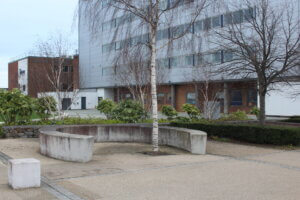

City campus. Photo credit: Hannah Marshall.
For students who are typically more introverted, the need for quiet and low stimulated spaces is even more important. Crowded corridors and noisy social areas can be intense, making it difficult to calm down. Quiet green areas offer an alternative, somewhere away from constant activity that suits individual needs.
Wide paths cut through campus and buildings sit closely together, leaving minimal room for natural environments. Whilst the layout is practical and promising, it can be overwhelming. Spending just ten minutes outside, surrounded by natural beauty has been proven to have positive effects on one’s mental health and productivity. The lack of outdoor spaces can limit opportunities to mentally switch of from academic stress or personal issues. With a few simple changes people would be encouraged to spend more time outside, resulting in an positive change in their academic performance and self esteem.
“There is not much space to switch off”
To get a deeper understanding of how your environment can reflect on your mental health , I interviewed a student who I worked with amongst the Sustainability team. They had previously conducted surveys that focused on the green spaces on campus and their research revealed that the issue lies in the usability of the outdoor spaces, rather than the quantity.
As they explained “a lot of people were mentioning that there’s not many seats, they wanted more seating areas such as picnic tables so they could eat outside” and “there was a lack of colours, they wanted more plants to make the outside space on campus more appealing”. As a result, many students adapt their routines to the lack of accessible outdoor spaces, Rather than staying on campus between lecturers, some choose to walk into city center while others decide to stay in busy campus cafes despite feeling overwhelmed.
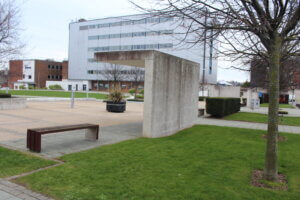

Seating areas at City Campus. Photo credit: Hannah Marshall.
Small changes, lasting impact.
Over time research has consistently shown that access to green spaces can reduce stress, improve your concentration and support over all wellbeing. Even just small parts of nature such as trees, a garden or quiet outdoor seating can make such a difference to your day. Without these, students find it harder to stay motivated as they can’t take meaningful breaks.
This is something that the university’s sustainability team is aware of.
Laura Middlemass, a member of the team works closely with environmental initiatives across campus. When I interviewed Laura, it was made clear that efforts are already being made to introduce nature based spots around campus but time and budget remain key challenges.
Whilst Laura agrees that additional sheltered seating areas would improve the campus, she suggests that smaller, immediate changes can be just as beneficial. Changes such as allowing grass and wildflowers to naturally flourish can enhance the visual appeal of the university whilst supporting biodiversity, particularly in the warmer months.
Laura highlights the importance of nature in everyday life “being out in nature is good for improving mental health, even just being able to see it out of a window”. This reinforces the connection between our environment and our mental health, suggesting that even simple pleasures such as the view of the river at St Peters campus can offer a sense of relief. She also points to ongoing efforts by the sustainability team, for example the planting of trees to create a blossom trail designed to encourage students and staff to engage with natural spaces.
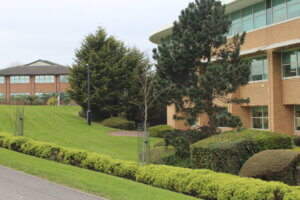
City campus. Photo credit: Hannah Marshall.
While conversations around campus design and student mental health continue, there are already small areas of green space available for students to find. At St Peters campus, the riverside seating area offers a quiet space to step away, community gardens and wildflower spots provide moments of calm and color for you to enjoy. Over at City Campus, green areas can be find amongst the buildings, along with scattered trees, flowers and open grass. Regardless of these spaces being limited, they highlight the potential for a balanced campus. One that provides an opportunity not just to study and grow, but to pause, reset and support student wellbeing. It is important that the outdoor spaces we have are promoted because in a space built for learning, students still need somewhere to breathe.