
The digital shock international students face at Sunderland University
Written by Takor Manyi on 31st March 2026
How students from around the world navigate University of Sunderland’s screen‑driven & cashless campuses.
By Takor Manyi
 International students walking through St Peter’s campus Sunderland. Photo Credit: Takor Manyi
When I arrived in Sunderland from Cameroon, I expected the hardest part of studying abroad would be the cold weather or distance from home. Instead, the biggest challenge was something I had never prepared for: learning how to survive in a society that functions almost entirely on screens and contactless payments.
I stepped off the plane with cash in my purse, confident it would help me settle in quickly. But I soon discovered, that alone could not help me function in this part of the world.
“I felt like I was the only one struggling — until I realised many international students were going through the same thing.”
My first attempt to open a UK bank account was rejected, leaving me unable to pay for basic things like transport. Even attending lectures needed a complete shift in mindset.
Back home in Cameroon, learning was mostly paper-based and face-to-face. Teachers delivered lessons in class, students took notes in exercise books, and assignments were submitted on paper. At Sunderland, almost everything depends on technology. Lectures and assignments are uploaded and submitted online. Communication with lecturers often happens via Email or Teams.
I realised very quickly that adapting to university life in the UK meant learning how to operate a whole new digital ecosystem.
And I soon realised I wasn’t alone.
A cashless campus.
Many students arrive from countries where cash is still widely used. In Sunderland, however, everyday life relies heavily on digital banking and contactless payments.
“The cashless system initially does create the sense of being an outsider,” says Adeoye, the Students’ Union President.
“When you’re unable to do the basics, it affects the way you view yourself in the community.”
For some students, even simple activities like paying for transport can become complicated.
“I arrived with £50 notes and the bus driver refused them,” says Gladys, a Kenyan student.
Without a bank account or digital payment method, everyday tasks such as shopping become difficult.
Opening a bank account takes time, especially for new international students who must provide documents, proof of address and university confirmation letters.
Until these accounts are set up, many students feel temporarily out of place.
Lost in the system.
Another challenge international students face is adjusting to the digital platforms used by UK universities: logging into university email accounts, accessing course materials online, and submitting assignments can be overwhelming for students who have never used similar platforms before.
Adeoye says this confusion is common among new arrivals.
“Outlook, SharePoint, Canvas — these aren’t common in many countries,” he explains.
“Some students don’t even realise they have a student email.”
Research from the Jisc found that international students often report lower confidence when using unfamiliar digital systems compared with domestic students.
Their International Students’ Digital Experience report highlights how adapting to multiple online platforms can be a major challenge for new arrivals. https://www.jisc.ac.uk/reports/international-students-digital-experience-phase-two-experiences-and-expectations
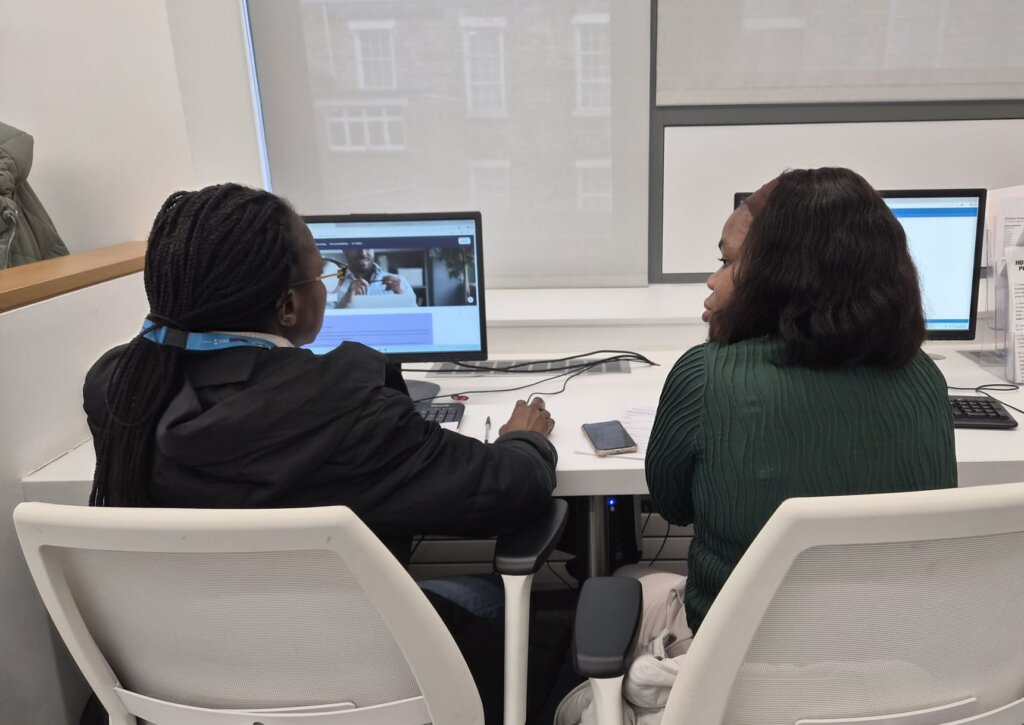
International students navigating the university’s digital systems. Photo Credit: Takor Manyi
For many students, the challenge is not just learning one system but navigating several at the same time.
Academic shock: from paper to screens.
For some students, this transition to digital education can be sudden.
“In Kenya, everything is paper-based. Here, lectures are on screens and assignments are online.” Gladys says.
Research from the British Council suggests that students from sub‑Saharan Africa and South Asia often experience the steepest shift when entering digital-first learning environments at UK universities.https://www.britishcouncil.org/research
“Some students couldn’t access anything because their phone wasn’t powerful enough.”
Chris Howson, University Chaplain
Students arrive without devices capable of running university software struggle during their first weeks of study.
Isolation behind the screen.
Studying abroad can be exciting, but it also comes with emotional challenges. According to research from the Office for Students, international students studying in the UK may experience homesickness, loneliness and cultural adjustment difficulties. https://www.officeforstudents.org.uk/publications/learning-more-about-international-students/
Instead of face-to-face discussions, many interactions with lecturers and classmates happen through emails, or online platforms.
Yet digital systems can also offer unexpected advantages.
“When I email my lecturers, they respond in less than 24 hours,” Gladys says.
The challenge, however, is simply learning how to confidently use these systems.
The hidden strength of international students.
Despite the challenges they face, international students contribute significantly to university life.
“Diversity is always a strength. International students enrich the classroom.” Adeoye says.
Different cultural backgrounds encourage wider discussions and help students explore global perspectives.
International students play an important role in the UK economy. Research from Universities UK International shows that international students contributed £41.9 billion to the UK economy in 2021/22, through tuition fees, accommodation and everyday spending.
https://www.universitiesuk.ac.uk/latest/news/international-students-boost-uk-economy
What needs to change?
Adeoye believes the university is improving, especially through the work of the Student Journey team.
“They’re involving students, running workshops, tailoring support,” he explains.
“The help is there, students just don’t always know how to access it.”
A spokesperson from Student Journey agrees that adapting to the university’s digital systems can take time.
“International students are adapting not just to a new university, but to a completely different digital culture,” they say
“We guide students through Canvas, Compass and Multi-factor Authentication. The aim is to support students rather than judge them for not knowing.”
Rather than relying on fresher’s week sessions, the university is moving towards ongoing support.
“We’re moving away from one‑off inductions and towards ongoing digital support.” he says.
Gladys agrees.
“Induction shouldn’t be just one week,” she says.
“Students need time to adjust.”
A sense of belonging

International students socialising at the university’s chaplaincy. Photo Credit: Rebecca Leighton
Beyond academic life, friendship evenings, cultural societies and peer communities provide spaces where students meet, share experiences and support each other.
For many, these relationships make the transition easier. Eventually, the digital systems that once felt confusing become part of everyday life.
And for me, the biggest change came when I realised I wasn’t the only one struggling.
“International students aren’t unprepared, they’re adjusting to high digital expectations.”
And yet, they adapt.
They persist.
They belong.