A step up? Has compulsory promotion from the Ebac Northern League been a blessing or a curse for North East clubs?
Written by Charlie Walker on 24th March 2026
Promotions are seen as some of the greatest achievements in a club’s history, so why are they met with mixed emotions in the North East? We take a deep dive into the reality clubs face when they move ‘up’ to the Northern Premier League.

Dale Pearson of Consett AFC celebrates with his team mates after he scores to make it 2-1 during the FA Vase Final match at Wembley. Credit: Paul Terry/Sportimage Sportimage/Alamy Live News
Non-league football in the North East is extremely popular – but also very unique.
This is because successful clubs in the Ebac Northern League Division One (Step 5 of the English footballing pyramid) have historically rejected promotion, mainly due to the cost of progressing to Step 4 – the Northern Premier League (NPL) East.
As a result, the region dominated the FA Vase – the national competition for Step 5 and 6 clubs. From 2009 to 2018, North East clubs won the competition eight times, including three consecutive victories for Whitley Bay.
However, that all changed when National League System laws made Step 4 promotion compulsory in the mid 2010s – with the hope of having a more fluid footballing pyramid.
Since the change, clubs have had varied success. Early promotion-takers South Shields are now fighting to be in the National League, while Marske United found themselves on brink of extinction in 2024 in the NPL due to high costs – leading to a charity fund which saved the club.
Recent seasons has shown that a sustainable approach to promotion may be the best option.
That’s the case for Consett AFC chairman Frank Bell, with the club producing consistent mid-table finishes since their Step 4 promotion in 2022.
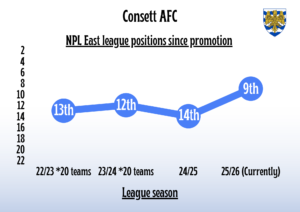
Infographic showing Consett AFC’s league positions. Credit: Charlie Walker
“The club is not your toy to play with. “It’s important that you don’t confuse your ambitions with your ability,” said Bell.
“A club like this is 127 years old. It’s important that I look after the club, so it stays for another hundred years. I know guys that have thrown money at football clubs instead of pension funds!”
Scott Lyndon, co-chairman of Heaton Stannington – who have enjoyed a rapid rise from Step 6 to Step 4 in five years – opened up about similar desires for a sensible strategy.
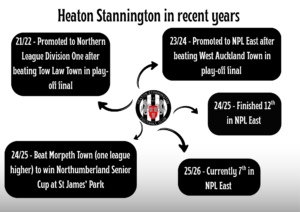
Infographic showing Heaton Stannington’s recent years of success. Credit: Charlie Walker
“We don’t have a rich owner. We’re a club run by volunteers and we’re owned by our members. We don’t have any shareholders,” Lyndon said.
“We have to generate all the revenue to support running the club and being sustainable.
“From a footballing perspective, it’s down to the management and the players. They’re the ones that have done the business on the pitch. We’ve tried to do what we can off the pitch to give the best environment and conditions to support that.”
But there’s also a huge cost when going up, which cannot be understated.
With ground requirements to be fulfilled, significantly more travel, and increased player wages, Consett’s Bell claimed, “it can take up to £50,000 to take this promotion.”
On the travel more specifically, going from local matches in the Northern League, to away fixtures in the likes of Lincolnshire and Yorkshire can put a huge strain on clubs.
“You lose probably between 50 and 100 supporters off your gate,” Bell continued.
“They’re not home supporters, they’re away supporters. Instead of having a local club who are well supported, clubs that you’ve associated with, and traditionally played over the years, you’re now playing a club which is 165 miles away.”
The Stan’s Lyndon had a different point of view, saying: “Last season, we had about six local games and all the rest were a distance away but, because it was our first season in the league, we operated coaches to every one of those 16 away games that weren’t local.
“It’s new grounds for people to visit and we had a lot of take-ups, so pretty much anyone that wanted to travel to one of the away games had a method of getting there.”
Fans are the backbone to the running of a club, and that’s even more paramount when stepping up.
According to Bell, “every sandwich, every burger, and every pint fans buy adds value to your club.”
Lyndon described support as “critical”, adding: “If we were getting crowds of 100-200 at this level, it would be really difficult to be sustainable without having a benefactor.
“We’re averaging almost 400 – that’s outstanding, and long may it continue.”
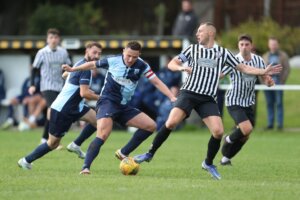
Heaton Stannington against Bishop Auckland at Grounsell Park. Credit: MI News/ Mark Fletcher/ /Alamy Live News
That said, North East clubs have not always had stability when stepping up to the NPL East. For example, despite finishing seventh in their first season after promotion, North Shields were relegated due to failing to meet ground requirements.
“[It was] incredibly tough to take – there’s no dressing that up,” North Shields director Sean Mulligan said.
“As a club, you judge yourselves on footballing merit first, and the group absolutely delivered on the pitch. But the reality of the National League System is that ground grading and infrastructure are non-negotiable.
“The frustration was we visited many new grounds, and the majority were not up to scratch then.
Mulligan added: “The likes of Brighouse Town – had no turnstiles in use but had them in the stadium so ticked the box. Pontefract – didn’t have a stand but had the construction work of this so ticked the box. Sheffield ground was falling to pieces, but all of these were deemed ok.”
Since the relegation – and several squad changes – North Shields have managed to find stability and a pathway for progression once more.
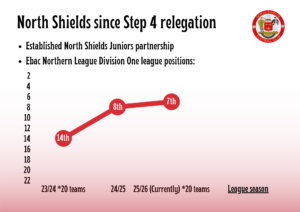
Infographic showing North Shields’ time after Step 4. Credit: Charlie Walker
Undoubtedly, compulsory promotion can be a struggle for clubs. This is evident this season, as three of nine North East clubs in the NPL East are currently in the relegation zone.
However, examples of sustainability and gradual growth in several clubs show that, perhaps, the leap to Step 4 isn’t as daunting as once feared.
“When I look at Northern League clubs now, I do sense a little bit of change in the way they’re functioning”, journalist Mark Carruthers said.
“Clubs are trying to strengthen their infrastructure, and trying to get things in place to make on and off-field development more sustainable.
“Clubs are now appreciating that they do have to make the jump and that if they do go up, they want to make a fist of it.”