Fanzines: Dissecting Football’s Forgotten Era of Literature.
Written by Ciaran Myers on 24th March 2026
In the 1980s/90s football fanzines were common place at football grounds with 1,816 having been produced at some point. Now the 75 that are left continuing the tradition are facing an uncertain future. In this article, Spark’s Ciaran Myers speaks to those involved in fanzines to find out why they were so important and what lies ahead for this forgotten era of football literature.
For the half a million tourists who visit the Abbey Road crossing every year it is a pilgrimage in honour of one history’s great bands, The Beatles. The famed studio has also hosted other legendary artists such as Elvis, Pink Floyd and The Rolling Stones. For those that journey to North-West London it is a chance to walk the path that their favourite artists once did; but they are also stepping in the footsteps of Rob Nicholls. Founder of the Middlesbrough fanzine, ‘Fly Me to the Moon’.
His song about Boro legend Tony Mowbray was recorded in the renowned studio and subsequently pressed as a single. After failing to sell the record, he gave them away as part of the fanzine. This tale is the epitome of the barmy creativity embedded within the football fanzine culture.
As Peter Slater, author of the ‘Football Fanzine Culture’ blog and researcher in the ‘Voice of the Fans’ exhibition in Leeds Central Library last summer told me, the football fanzine culture was born as a product of a punk culture that was prevalent in the 1980s.
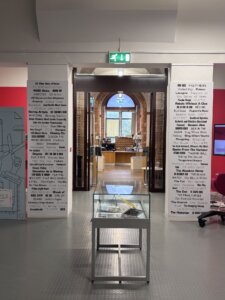
The Voice of the Fans Exhibition at Leeds Central Library (Picture: Peter Slater).
“Punk had changed the attitude of people towards music and brought into this DIY, anybody could do it attitude. And that washed over into football and it washed over into self-publishing and it sort of coalesced around the protest movement”.
He explained that a common myth is the 1989 Hillsborough disaster caused the scene to explode. The reality is that fanzines were already being produced in number but the disaster did help ‘galvanise’ supporters to find their voice.
Martyn McFadden, editor of A Love Supreme (ALS), a Sunderland fanzine that has ran since 1989 attests to the self-starter attitude of those who created the publications. He said: “It was the whole DIY, independent record label sort of ethos. It was where you just produced something yourself and that’s your art and passion.”
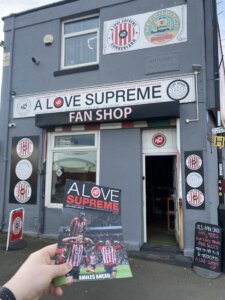
The A Love Supreme Shop and fanzine. (Picture: Ciaran Myers).
ALS has built a reputation for being a well-produced fanzine, originally this was due to the help of Martyn’s sister ex-boyfriend who owned a design company. On Tyneside, The Mag, co-founded by Chris Tait was another publication that was produced to a high quality.
Chris told me: “We took a decision very early on that we wanted something that would be on the shelves at WHSmith, the idea was to have it as professional looking as possible.”
Despite this, a lack of professional equipment did not stop other fanzines from producing their work. In a blog post, Slater identifies that ‘self-publishing was enabled by changes in technology. The printing and copying devices now available create a second Gutenberg movement.’
The accessibility of producing and contributing to fanzines, that relied on readers’ articles for content, led to the start of many successful careers. Author of Trainspotting, Irvine Welsh, started by writing under pseudonyms in various Hibernian fanzines. Andy Pattullo, chief football writer at The Scotsman, started by contributing to fanzines. Andy Mitten founded the United We Stand fanzine at aged 15, he balances continuing to edit it with writing for The Athletic. McFadden says the Sunderland press office is ‘full’ of individuals who used to contribute to ALS.
Football fanzines were also closely linked to music as the two cultures often intertwined; as seen earlier with Rob Nicholls’ Abbey Road exploit. Fanzines were known to adventure into music; ALS also produced their own records as McFadden recalled.
“I’d been in a band previously so I had that musical link. When we played Liverpool in the cup final, we worked on the official 1992 FA Cup final song with the players and released it on A Love Supreme Records.
“Then when Peter Reid came in, we released a single, ‘Cheer Up Peter Reid’, which chartered and we gave all the money to a cancer charity of his choice. Then when we got promoted, with Niall Quinn we released a single called ‘Niall Quinn’s Disco Pants’.”
Many respected artists also got a start in their creative careers within the fanzine space. Pete Doherty, frontman of alternative indie band The Libertines, created a QPR fanzine, ‘All Quiet on the Western Avenue’. Only five issues were produced but they are now highly sought after memorabilia.
As Slater explained, this was a part of the wider music and culture of fandom on the terraces. He said: “That was because of people like Pete Hooten and The Farm and fanzines like ‘The End’ (a Liverpool fanzine that Hooten ran). There was a mixture of football, fashion, music, style type of thing.”
The connection between music and fanzines can be seen in names of many who took inspirations from bands or song titles. A group of Shamrock FC fans created the ‘Hoops Upside Your Head’ fanzine based on the 1979 Gap Band hit ‘Oops Upside Your Head’.
A walk around an English football stadium today will highlight the decline of football fanzines with it now uncommon to see a seller attempting to shift their stock of a self-produced production. Slater believes that the internet ‘killed’ print fanzines.
He said: “The internet came along and forums did what fanzines did quite a lot better so everybody just moved. It was just much easier to go onto a forum.”
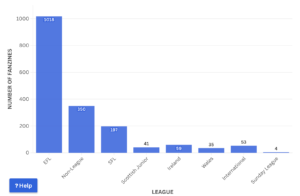
Statistics of fanzines that have been catalogued so far. (Credit: Ciaran Myers/Peter Slater).
Despite this, there is still some hope of a possible revival, two new fanzines being set up this season. ‘Over the Boundary’ at Oldham has been relaunched alongside ‘A View from the East Bank’, a Sheffield Wednesday ‘zine. The latter was an act of protest against former owner Dejphon Chansiri and with more supporters becoming disillusioned with how their clubs are being run, especially in the Premier League, there is a chance that more fanzines will pop up to fight for supporter interest.
It is improbable that the fanzine culture will ever return to its peak but modern football experience would benefit with witty, informed and entertaining literature being present again on match-days.