Review: Audrey Amiss – Kitchen Sink Realism at Sunderland’s Culture House
Written by Connor Kirkbride on 14th October 2026
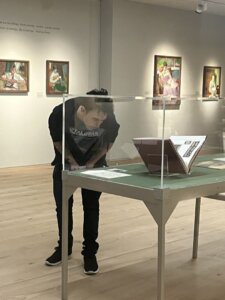
It was Oscar Wilde that once said, “All art is quite useless,” in his preface to The Picture of Dorian Gray. That statement is either one of the cleverest sentences that anyone has ever said about art, or the sort of statement which becomes clever chiefly because it was Oscar Wilde that said it. Had it been some geezer in a Wetherspoons, muttering it over his third pint at 10am, history might have been less generous. Though I would still say that I carry some sympathy for the sentiment.
There is also Sturgeon’s Law, named for the American sci-fi writer Theodore Sturgeon, which proposes rather definitively that ninety percent of everything is crap. Be it books, television, films, paintings, journalism, university assignments or quite possibly even this article you’re reading. It is a rather admirably democratic theory, because it allows us to accept two things at once: that art matters enormously and that a hell of a lot of it is tripe.
I must admit, without shame, that I carried the spirit of both these men on my shoulders as I walked into Sunderland’s newly opened Culture House and, more specifically, the Northern Gallery for Contemporary Art’s Audrey Amiss: Kitchen Sink Realism exhibition.
To be clear immediately, I was hesitant about going. This wasn’t so much to do with Audrey Amiss as it was my occasionally strained relationship with art galleries. I love art. I am attempting, somewhat recklessly, to make a life involving it for myself, albeit with sentences rather than watercolours. But galleries and exhibitions can sometimes make me feel as though I have arrived late to a party where everyone else received an important set of instructions in their invite.
I’ve noticed a particular stance many people adopt when faced with paintings. We’ve all seen it. Hands behind the back, head tilted about seven degrees to one side. A solemn expression suggesting that a long-repressed childhood memory has finally come to the surface. And I have tried this myself, but I’d be lying if I said it improved my understanding of abstract artwork.
Culture House itself does considerably more to break that intimidation than I expected. The building itself, which opened this past September in Keel Square and now houses the Northern Gallery for Contemporary Art on its second floor, feels less like a temple demanding reverence and more like somewhere Sunderland hopes people actually enter.
There is a lot going on in it. I wandered my way through material about space, encountered a wall with the wishes of strangers pinned on it, and at one point, found myself being interviewed by three primary-school children asking me questions about stress that I felt bad telling the truth about. Definitely an experience that did nothing to quell my suspicion that children make demonstrably better journalists than adults, because they have not yet learned to pretend they understand your answers.
But what I had come for was Sunderland’s own Audrey Amiss. And before seeing much of the work she had crafted, my fellow students and I were given an introduction to her by curator Jonathan Weston. His enthusiasm was apparent but not theatrical. There was no booming proclamation that we had entered the world of a forgotten genius. Instead, he seemed genuinely, quietly invested in telling us all who this woman had been and why her work deserved to be there. And there was quite a lot to tell.
Amiss was born in Fulwell in 1933, studied at Sunderland College of Art and later won a scholarship to the Royal Academy Schools in London, much to the praise of her hometown, as is clear in the cuttings from the Sunderland Echo at the time. She worked relentlessly throughout her life, across painting, watercolour, pastel, drawing and photography. “Relentless” is not my own journalistic exaggeration either. Wellcome Collection estimates that she filled roughly 50,000 sketchbook pages across her lifetime. FIFTY THOUSAND. At my current rate of executive dysfunction, I calculate that I should reach that figure sometime around the heat death of the universe.
Amiss painted what was around her. Streets, people, cafés, journeys, beaches. Other folks going about their lives. The exhibition takes its title from Amiss herself, who once described having belonged to the tradition of social realism, the “kitchen sink school of painting”, before declaring herself “avant garde and misunderstood”. I find something wonderfully defiant about that sentence and also wonderfully defiant about the sheer quantity of work. Amiss, from what I can understand, possessed the artistic equivalent of an inability to shut up. And I mean that in the most affectionate way possible. The world happened in front of her, and she seemed compelled to answer it.
That said, not every answer worked for me. I feel it’s important to say. Among the pieces was a sketch of spectators at a Fulham V. Sunderland football match which Mr. Weston described, in a tone that raised one of my eyebrows higher than the other, as “very abstract”. I stared at this piece, and it stared back, insofar as a scribble of colours, shapes and lines can stare. I even tried the classic gallery stance I had seen before. Nothing. It was then that Wilde and Sturgeon reappeared on my shoulders like irritating flies. Perhaps this was simply part of the fabled ninety percent. Perhaps somebody with vastly greater knowledge of visual art could explain the technique, movement, intention or historical significance and seventeen other things I had obviously failed to appreciate. I suspect, even if I had listened to them politely, I still wouldn’t have felt anything. And to be honest, I think that is allowed.
Then I found Roker. More specifically, a beach scene. And suddenly none of the intellectual scaffolding mattered quite as much. The painting transported me somewhere immediately familiar: The barrier between sand and concrete, the seemingly endless row of park benches, and a blue sky carrying the distinctly North-Eastern promise of a coming gloom. I knew Roker, and I knew what Amiss was portraying. Not academically. Not because someone had explained its significance on a plaque. I knew it in the unconscious way you know somewhere that has existed around you for most, if not all, of your life. I had been to that beach many times, and all long after she had crafted this particular piece. It had been the location of many memories, some happy and some melancholic.
That raises an obvious problem. Would I have cared as much about that painting had I been born in Birmingham? Probably not. For a while I thought this represented some weakness in my artistic judgement. Perhaps I wasn’t responding to Amiss’ ability at all. Maybe she had pressed that large, reliable nostalgic button marked ‘SUNDERLAND’ and I, dutifully conditioned, had produced the required emotional response. But the more I thought about it, the less convinced I became of this theory’s relevance. We do not enter galleries empty. Nobody strips themselves of memory at the door and becomes a perfectly objective observer of art. We drag everything in with us, be it childhood, geography, grief, prejudice, affection, boredom, bad relationships, good relationships, the weather that morning, whether we have eaten lunch. It’s impossible, and foolish, to attempt to restrict ourselves when entering an area that requires careful analysis and consideration.
Perhaps recognising Roker wasn’t interfering with my appreciation of the painting. I suspect that Roker was my appreciation of the painting. And in the same way not understanding what others see in very abstract scribblings is allowed, I feel true appreciation of a piece due to its familiarity is also allowed. And it was this appreciation that opened the door wider for me to travel deeper into Amiss’ life, where, it some became clear, the paintings, drawings and collected cuttings were only part of the story.
She documented almost everything. Her archive contains scrapbooks, account books, record books and logs alongside the more conventional artistic material. Receipts were preserved and annotated. Tickets had survived. Food packaging found its way into books. Purchases could be recorded down to the penny. Letters were logged with details including their recipients, postage and sometimes even the type of envelope used. Today, in 2026, we might give some of this a pleasing, Instagram-friendly label like “Junk Journalling”. Audrey Amiss, however, appears simply to have regarded it as Tuesday.
At first this habit amused me. Then it fascinated me. Eventually it became the part of the exhibition that affected me the most. Because why would somebody feel compelled to document so much? I don’t know if even she knew, and I certainly don’t know the answer. Plus, it would be arrogant to diagnose a long-departed woman through a collection of bus tickets. But once you go a little further into Amiss’ life, all this preservation takes on another dimension.
Her relationship with mental health services began while she was studying at the Royal Academy Schools. She experienced what she called her first breakdown, spent time in hospital, and over the decades that followed was detained in psychiatric units at least eleven times according to Wellcome Collection’s research. Amiss later identified herself as a psychiatric survivor campaigning for a reform of the UK’s mental health system. While I can’t say with honesty that I have experienced quite what Amiss experienced, I have never been sectioned, and it would be grotesque to pretend that a very late diagnosis of ADHD gives me some secret access to her life. It does not. But it does give me enough familiarity with one small patch of the territory to recognise something in the distance.
Looking at Amiss’ work in that gallery, I found myself contemplating what it must have been like to experience severe psychological distress in an era with even less public understanding, far less sympathetic conversations and a psychiatric system that she herself felt frequently harmed by. I don’t know what it was like, but I was wondering. And that distinction matters. And from that wonder, something irritating happened. The artwork I had come intending to judge began judging me back. I stopped asking whether every individual painting or drawing was “good”. I became more enthralled by the fact that Audrey Amiss kept creating them.
Through illness, distress, apathy, hospitals, isolation and everything else that accumulated in her mind across almost 80 years, she kept looking at the world and deciding not only that it needed to be recorded, but that it was worth it. A café, a stranger, a man sleeping, a football crowd, a receipt, a sandwich, Roker Beach, whatever was there was worth being recorded. It’s possible that my admiration for that persistence prejudices me in favour of her work. Perhaps there is some austere critic somewhere who would consider this a hopelessly sentimental and surface-level response to art. I can say, with conviction, that I don’t particularly care.
If Wilde was right and all art is useless, then perhaps its uselessness is precisely what allows us to choose what is means to us. If Sturgeon was right and ninety percent of everything is crap, nobody has yet established an independent, international committee responsible for deciding what is included in the ten percent that isn’t. I myself decide, whoever is reading this decides. Messily, personally, inconsistently. The football sketch can remain in somebody else’s ten percent, while I am taking Roker Beach.
And, perhaps more importantly, I am taking Audrey Amiss’ insistence on continuing to create things. That stayed with me, as somebody trying to become a writer and occasionally wondering whether I possess either the ability or mental organisation required to accomplish it. Amiss’ life does not provide some neat, motivational poster about overcoming adversity. Her troubles should not be reduced to an inspirational obstacle, placed conveniently before artistic victory. Her creativity and her suffering appear far more tangled than that. Yet she continued. And that is something I feel I needed to see.
Sunderland’s Culture House and University certainly deserve credit for providing somewhere that I could see this. Its new gallery feels welcoming rather than sealed from the city surrounding it. And if this first exhibition, aided brilliantly by Jonathan Weston’s knowledge, is anything to go by, then my second visit is more or less guaranteed. The Audrey Amiss exhibition is the NGCA’s first for the public in the Culture House, which feels like an appropriate beginning: a new Sunderland cultural space opening with the works of somebody born a few miles away.
I entered prepared to decide whether I liked what I saw, and I left thinking that this had been the least interesting question I could have asked. Over a decade since she passed, so many things Audrey Amiss considered worth preserving still exist. Someone kept looking at the world and kept making things from it. And now another Sunderland-born person, standing in a gallery in the city she left behind, found himself looking at them and thinking about why he wants to keep creating things too.
She had paint, pencils, scraps of paper and fifty thousand sketchbook pages. I have a keyboard and words. For now, that’ll do.
Connor Kirkbride,
Creative & Professional Writing Student,
14th October 2026