Say Nothing – a compelling adaptation of a complex story
Written by Elizabeth Earl on 3rd December 2025
REVIEW
Say Nothing is not a comprehensive history of the Troubles – nor does it pretend to be.
The series focuses on the stories of a select group of people during the conflict; kidnapped Belfast mother Jean McConville, IRA members Brendan Hughes and Dolours and Marian Price, and former Sinn Féin leader Gerry Adams. As the show dutifully notes at the end of each episode, Adams has always denied any involvement in the IRA.
Across its nine episodes, Say Nothing covers over four decades of events from the late 1960s to the 2010s, and is punctuated by scenes depicting Dolours Price and Hughes being interviewed for the Boston tapes, an academic oral history project on the Troubles.
Adapted from investigative journalist Patrick Radden Keefe’s book of the same name, the series has earned a 94% rating on Rotten Tomatoes, and it’s easy to see why.
The portrayal of the young activists-turned-IRA-volunteers in the early episodes is incredibly compelling.
Alongside the Price sisters, viewers are swept up in the excitement and camaraderie of riots, bank robberies and clandestine operations – or, as episode two’s title calls it, the ‘land of password, wink and nod’, a reference to Irish poet Seamus Heaney’s Whatever You Say, Say Nothing.
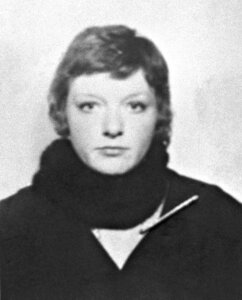
Dolours Price
An adaptation of a story as divisive as the Troubles is guaranteed to attract criticism.
Say Nothing is not a balanced or both-sides account of the conflict; it tells the story of a particular, controversial group. Although some of its protagonists are convicted terrorists, the series portrays these characters in a way which encourages sympathy from viewers.
The British public’s first impression of the Prices may have been as the ‘Sisters of Terror’, as they were branded by the media, but viewers of Say Nothing first encounter them as idealistic protestors who begin to question the effectiveness of peaceful resistance after being attacked during a civil rights march.
The events dramatised in the series are not ancient history, and some of the people depicted have taken issue with the retelling. Marian Price sued Disney for defamation over a scene in the final episode which depicts her shooting Jean McConville.
McConville’s son, Michael, said the series’ portrayal of his mother’s disappearance was “horrendous” and “cruel”. He also criticised the timing of its original release on Disney+ – close to the anniversary of his mother’s death on 1 December, the same date on which Channel 4 aired the series’ first episode this year.
His comments raise a wider ethical question about the adaptation of real-life events into fiction: should we really be turning a real, living person’s traumatic experience into entertainment?
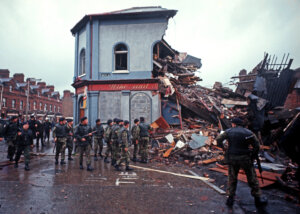
BELFAST, NORTHERN IRELAND – OCTOBER 1974. Loyalist Bar, blown up by the Irish Republican Army during The Troubles.
The series portrays the harsh reality of the conflict, which left over 3,500 people dead, in its own way.
Rather than focusing on victims of bombings or shootings, it illustrates the personal emotional impact of armed struggle on IRA members through moving performances from Lola Petticrew (as Dolours Price) and Anthony Boyle (as Brendan Hughes).
There are also impactful, hard-to-watch scenes in which characters are subjected to violent interrogation at the hands of the British army.
Arguably the darkest moment of the series comes when the Price sisters, imprisoned in London for their part in the 1973 Old Bailey bombing, are force-fed by medical staff and reach the brink of death during their hunger strike.
The final years portrayed in the series are worlds away from the excitement and action of the early episodes. Following the Good Friday Agreement, Adams enjoys a successful career in politics, while Hughes and the Prices struggle to accept the end of the conflict and to adapt to normal life.
Dolours sums up the mood of the final episodes when she asks her sister, “Do you ever get the feeling it was all for nothing?”
Despite its expansive timeline, and the transition from younger to older actors for several characters, the series’ story remains cohesive and easy to follow throughout.
Say Nothing may not be a fair and balanced retelling of the complex, decades-long conflict in Northern Ireland, but it is incredibly moving television.
All episodes of Say Nothing are available to stream on Channel 4 now.